


Vertical Wastewater Mixer: A Key Device to Keep Wastewater Treatment Active
Leave a message
|
|
Author: Mike Wastewater Treatment Engineer Water Treatment Expert Time: May 28, 2026 Introduction: I'm Mike. I've been deeply engaged in the field of wastewater treatment and environmental protection equipment for a long time, with extensive front-line experience. I focus on engineering implementation and operation optimization, sharing practical and applicable industry insights. |

Products Description
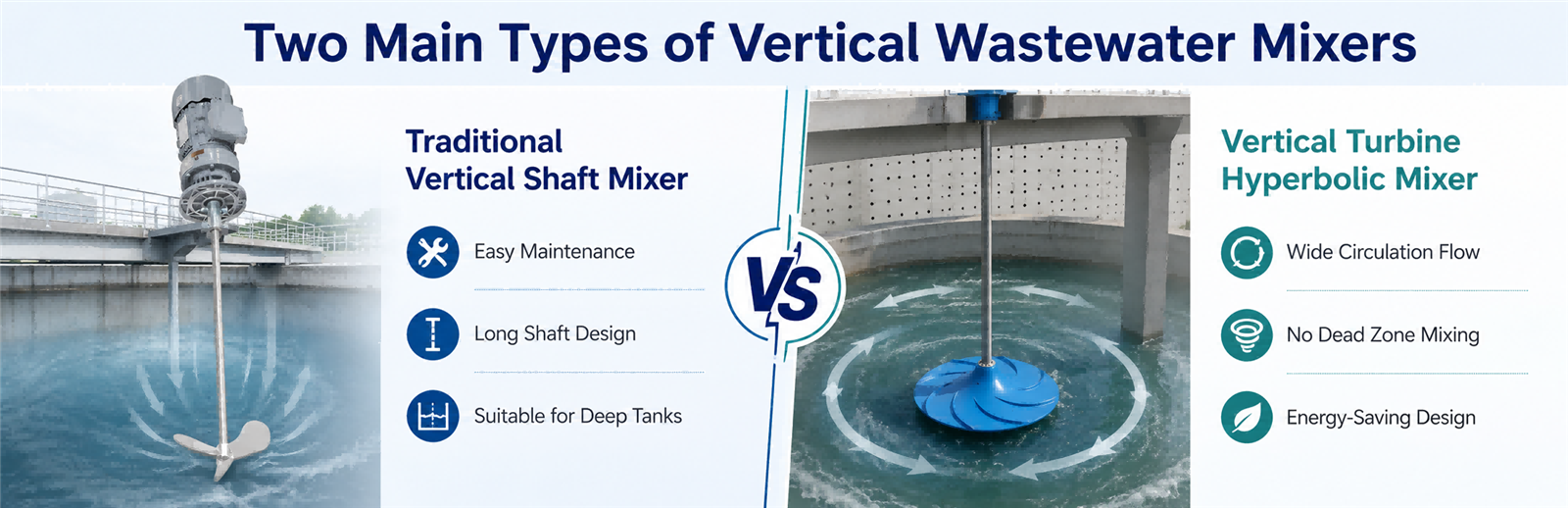
There are two primary types of vertical wastewater mixers based on design and function:
-
Traditional Vertical Shaft Mixer The motor is mounted above the tank and connected to the underwater impeller via a long shaft. Its biggest advantage is no underwater connections, enabling easy maintenance, a longer motor lifespan, and it is especially suitable for deep tanks with a small diameter-to-depth ratio.
-
Vertical Turbine Hyperbolic Mixer Featuring a unique hyperbolic impeller structure. When the impeller rotates, liquid moves tangentially along the impeller circumference under gravity, reflecting off the tank wall to form a top-to-bottom circulating flow. It generates both axial and radial cross flows with no dead zones, delivering significant energy savings of 30%-50% compared to traditional mixing methods.
Applications
Vertical wastewater mixers are used throughout the entire wastewater treatment process:
-
Equalization Tank: Balances water quality and volume, preventing debris sedimentation.
-
Anaerobic/Anoxic Tank: Provides gentle mixing to create optimal conditions for anaerobic microorganisms and promote organic matter decomposition.
-
Coagulation/Flocculation Tank: Facilitates rapid mixing of chemicals with wastewater.
-
Sludge Tank: Prevents sludge settling and maintains sludge activity.
Core Working Principle
Both types share the same core goal: generating water flow, preventing sedimentation, and promoting mixing.
Selection Criteria
To recommend the right mixer, we require the following parameters:
-
Tank dimensions (length, width, height)
-
Water depth
-
Shaft and impeller material (or details of the mixing medium if unknown)
-
Electrical specifications (voltage, frequency, etc.)
Need a suitable vertical mixer for your wastewater treatment tank?
Send us your tank size, water depth, material requirements, and power supply details. Our team will help you select the right mixer and provide a customized quotation.
Core Advantages Over Horizontal Mixers
Compared to horizontal mixers and other mixing equipment, vertical mixers offer prominent core advantages, ideal for users with requirements for space, operation and cost:
-
Space-Saving: Vertical design occupies minimal space, fitting easily in narrow workshops and improving space utilization.
-
Easy Operation: One-touch start/stop with an intuitive control panel; workers can operate it with minimal training, saving labor costs.
-
Low Maintenance: Simple structure with easily replaceable wearing parts; daily maintenance is simple, reducing downtime.
-
High Efficiency: Fast and uniform mixing, far more efficient than manual mixing, reducing material waste.
-
Cost-Effective: Affordable price, low energy consumption and high durability, saving long-term operational costs.

Maintenance Notes
Regularly check motor insulation and cables.
01
Promptly remove entanglements (plastic bags, fibers, etc.) from the impeller.
02
Replace reducer lubricant after 200-300 hours of operation, then every six months to one year.
03
Before restarting after long-term shutdown, check motor insulation to avoid startup issues caused by sediment buildup.
04
Summary
Vertical mixers are unsung heroes in wastewater treatment plants. With a simple structure, efficient performance and low maintenance costs, they are widely used in many industries, especially for small and medium-sized enterprises and small processing plants. Requiring no complex skills or large space, they meet various mixing needs, greatly improving production efficiency and saving labor costs.
From vertical circulation to hyperbolic designs, from anaerobic tanks to equalization tanks, they quietly drive water flow, suspend sludge and promote reactions, contributing to clean water resources.


