


What is a Sewage Bar Screen?
Leave a message
By Mike
Time: January 16, 2026
Introduction: long-term engaged in the production of wastewater treatment and environmental protection equipment,
a wealth of on-site construction experience, focusing on the process ideas/equipment selection/operation points
#sewage treatment #wastewater treatment #sewage Bar Screen
Wastewater treatment refers to the process of treating wastewater containing pollutants generated in production or life using physical, chemical or biological methods and technologies to remove or reduce the content of harmful substances in it, so that the water quality meets environmental discharge standards or specific reuse requirements.
However, the first step is to remove the largest solid particles from the wastewater. Therefore, we need a mechanical Bar Screen to intercept impurities, grit, etc. in the wastewater.
What is a wastewater Bar Screen and how does it work? Read on to learn more.
Wastewater Bar Screen
A Bar Screen is a piece of equipment used to pre-treat wastewater and is usually located at the front end of a wastewater treatment system. Its main function is to filter out large particulate matter in the sewage, such as tree branches, leaves, paper, plastic bags, etc.
Removing and intercepting these large particulate materials to prevent them from entering the subsequent treatment equipment, causing unnecessary wear and tear and damage to the equipment, affecting the treatment results and normal operation of the equipment, and reducing equipment maintenance and potential problems throughout the wastewater treatment system.
Working Principle
Initially the Bar Screen consists of a set of parallel metal bars mounted vertically where wastewater passes through. As water flows through the bar gaps, debris larger than the gaps (e.g., plastic bags, twigs, fibers, etc.) is trapped, but the trapped material causes congestion, resulting in a rise in the water level.
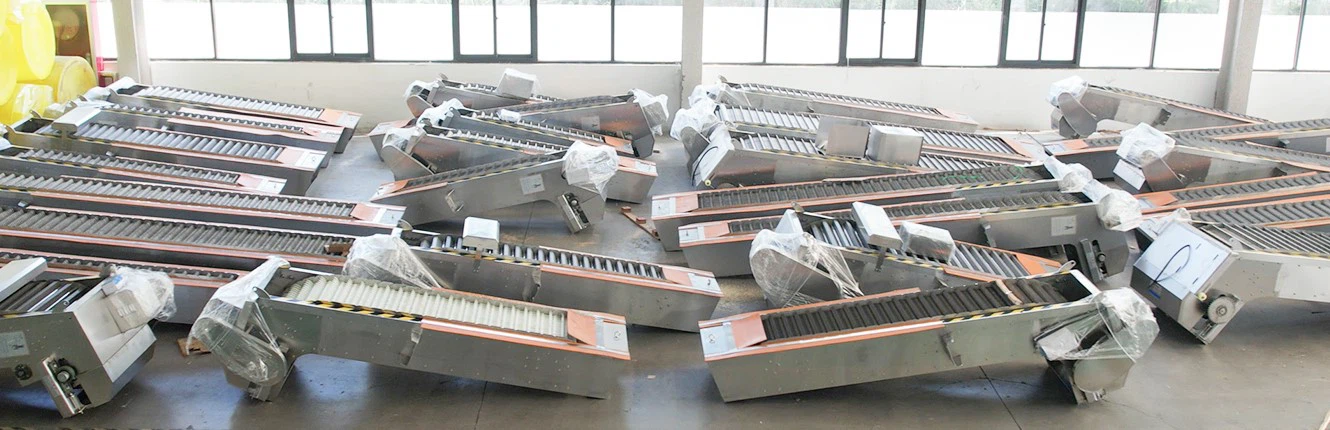
Widely used today is the rotary machine Bar Screen (Rake Tooth Rotary Bar Screen), which consists of a series of parallel metal or plastic rake teeth, and waste removal is accomplished by a mechanical device.
Driving device through the reducer to drive the active sprocket rotation, so that the chain and rake teeth composed of rake teeth chain assembly along the established track continuous rotary operation.
Through the rake teeth chain movement against the direction of water flow, rake teeth of the special structure of the shape, so that the rake teeth chain to carry debris to reach the upper end of the reverse movement, before and after the rake between the relative self-cleaning movement, prompting debris to rely on gravity to fall off will be intercepted to the top of the conveyor to the top of the automatic unloading through the transportation of conveyor, transfer to the garbage transport vehicle.
This way large particulate matter will not cause clogging and the water flow will remain steady. Without this clearing mechanism, the Bar Screen will quickly clog under high water flow and high levels of large particulate waste.
Main categorization methods
| Classification | Types | Key parameters | Application scenarios |
|
Grid spacing |
Coarse Bar Screen | 50-100mm | Pumping station intake, front end of large sewage treatment plant |
| Medium Bar Screen | 10-40mm | Pre-treatment of small and medium-sized sewage treatment plants | |
| Fine Bar Screen | 3-10mm | Before deep treatment or front-end of MBR process | |
| Clearance method | Manual cleanup | Tilt angle 50°-60° | Small treatment station (sludge volume <0.2m³/d) |
| Mechanical cleanup | Tilt angle 50°-90° | Large treatment plant (automatic continuous operation) |
Difference between Manual Bar Screen and Mechanical Bar Screen
In the whole set of wastewater treatment system, whether the water flow is kept stable, whether the equipment is running smoothly, to prevent clogging is very important, there are many kinds of mechanical Bar Screen, some just need to do a simple decontamination in front of the sewage, according to the user's needs are different, the mechanical Bar Screen has a manual cleanup as well as automatic processing.
Manual Bar Screen
Manual Bar Screen, i.e., manual Bar Screen is mainly cleaned manually, relying on manual cleaning of the dirt intercepted on the bars on a regular basis, requiring manual use of tools (such as rakes) to remove clogging, to prevent clogging of the gaps between the Bar Screen.
The gap of manual Bar Screen is between 20~60mm, because it needs to be cleaned manually, so the tilt angle is set between 50°~60° which is the most convenient for cleaning, and the effective area of the grid can be increased by 40% ~ 80%, which is easy to be cleaned and reduces the loss of water head.
Usually in small wastewater treatment stations, rural decentralized wastewater treatment facilities, low concentration of suspended solids, small treatment scale scenarios or slow-flowing riverside, generally the amount of pollutants that need to be retained is small, are set up to manually clean up the Bar Screen.
Advantages include simple structure, low initial investment (no motor, transmission system), and low maintenance cost (no complex mechanical parts).
However, due to the increase in labor costs, the cleaning method is time-consuming and labor-intensive, and requires regular manual inspection, which often leads to clogging due to untimely cleaning, affecting the treatment effect, and there are dangers in the cleaning process, as manual contact with sewage filth poses a health hazard, and the use of the manual Bar Screen is now decreasing in smaller factories, and it is being replaced by the automated Bar Screen.
Mechanical Bar Screen
Mechanical Bar Screen can continuously and automatically intercept and remove various shapes of debris in the fluid, which is widely used not only in municipal wastewater treatment, water industry, power plant intake, but also in the textile, food processing, paper, leather and other industries in the wastewater treatment process in the pre-screening.
As one of the advanced solid-liquid screening equipments, Bar Screen decontaminator has won wide recognition in the industry for its high degree of automation, high separation efficiency, low power consumption, no noise, good corrosion resistance and other advantages.
The Mechanical Bar Screen has a gap between 2mm-20mm, (customizable) the overall material of the body is SS304, because no manual cleaning is required, the installation angle is 75° (can be decided according to the site conditions).
Nowadays, all new wastewater treatment plants are equipped with self-cleaning mechanical Bar Screen as the main equipment because of the automated process, which can be adjusted at any interval of the equipment operation to realize cyclic operation, can be automatically controlled according to the difference of liquid level before and after the Bar Screen, and is equipped with the technology of over-electricity protection, which leads to a significant reduction in the cost of operation and maintenance.


Choosing the right Mechanical Bar Screen
Mechanical Bar Screens play an important role in wastewater treatment as the first step in a complete wastewater treatment system, so you need to choose the right Bar Screen for your wastewater treatment plant to reduce your operating costs.
Phone Number and WhatsApp
+8615037320403
info@ecowatertechs.com


