Plate and Frame Filter Press: A Powerful Solution for Industrial Solid-Liquid Separation
Leave a message
|
|
Author: Mike Wastewater Treatment Engineer Water Treatment Expert Time: August 27, 2026 Introduction: I'm Mike. I've been deeply engaged in the field of wastewater treatment and environmental protection equipment for a long time, with extensive front-line experience. I focus on engineering implementation and operation optimization, sharing practical and applicable industry insights. |

Primary Keyword:Plate and Frame Filter Press;Secondary Keywords;Sludge Dewatering Filter Press;Industrial Filter Press;Solid Liquid Separation Equipment;Wastewater Filter Press;Industrial Sludge Dewatering;Filter Press Working Principle;Filter Cake Dewatering;
In wastewater treatment, mineral processing, chemical production, food processing, pharmaceuticals, and many other industrial applications, one piece of equipment plays a critical yet often overlooked role: the Plate and Frame Filter Press.
It efficiently handles demanding solid-liquid separation tasks, significantly reduces material moisture content, improves resource recovery, and helps lower environmental treatment costs.
Although industrial equipment may seem complicated at first, the operating principle of a plate and frame filter press is actually quite straightforward. In this article, we will explain its working principle, operating process, key advantages, typical applications, and maintenance requirements, making it easy even for first-time users to understand.
What Is a Plate and Frame Filter Press?
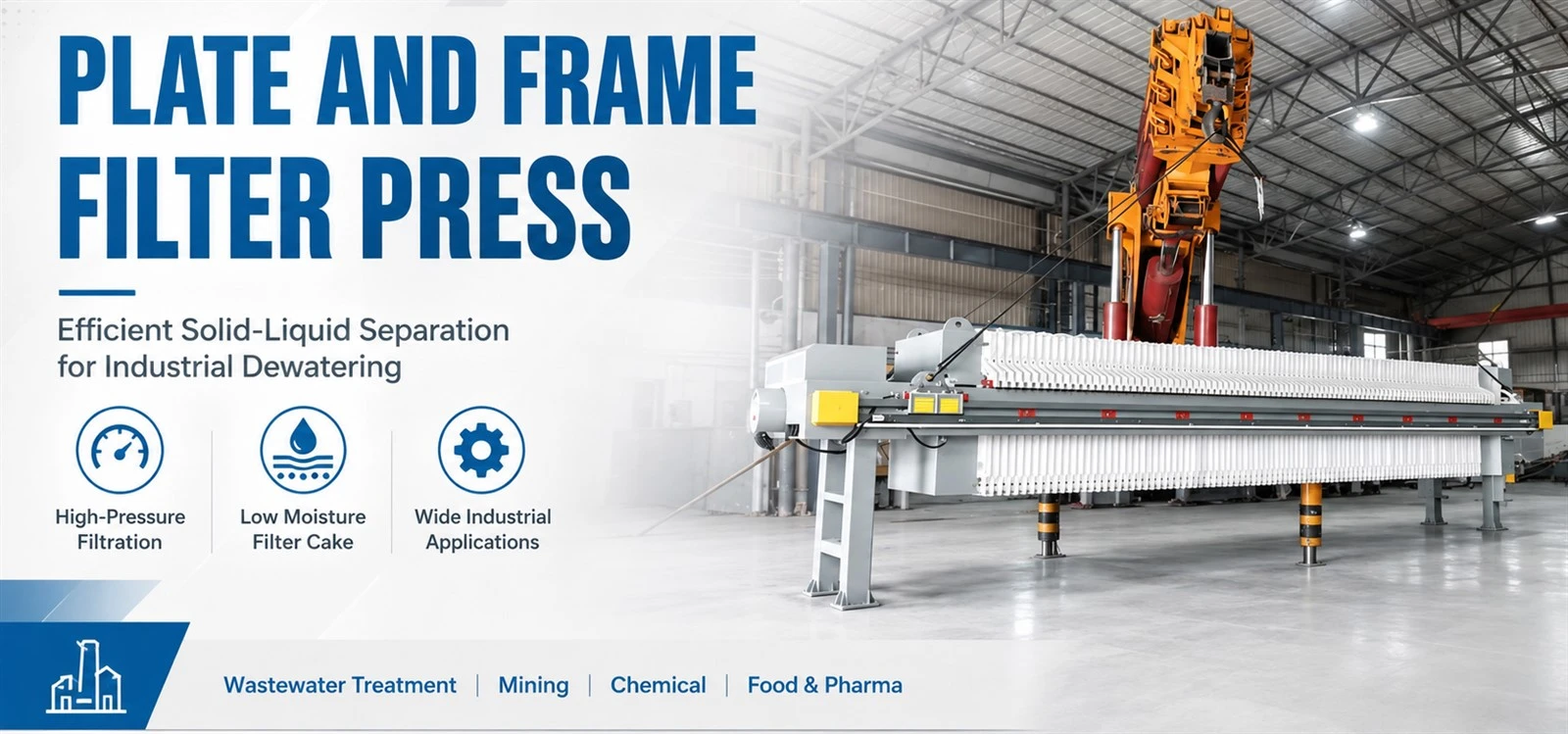
A Plate and Frame Filter Press is a batch-operated, pressure-driven solid-liquid separation system. It is one of the most widely used types of equipment for industrial sludge dewatering, slurry filtration, and material purification.
Simply put, its main purpose is to separate suspensions, sludge, slurry, and other mixtures containing solid particles into two products:
-
Clear filtrate
-
Dewatered solid filter cake
A simple way to understand the process is to imagine a large industrial press. Pressure is applied to the material to remove as much liquid as possible, while the solid particles are retained inside the filter chambers.
Compared with conventional filtration equipment, a filter press can achieve a much higher degree of separation and more effective dewatering.
The complete system has a relatively simple and robust structure. Its main components include:
-
Filter plates
-
Filter frames
-
Filter cloths
-
Hydraulic closing system
-
Feeding system
-
Cake discharge system
This simple mechanical design provides reliable operation, a low failure rate, and good adaptability to demanding industrial environments.
Working Principle: High-Pressure Filtration for Efficient Separation
The plate and frame filter press operates based on pressure differential filtration.
The hydraulic system generates a pressure of approximately 0.6–2.0 MPa, allowing the material to be filtered under pressure inside sealed filter chambers. The liquid passes through the filter cloth while solid particles are retained, achieving effective solid-liquid separation.
Under suitable operating conditions, the overall filtration efficiency can exceed 95%.
A complete filtration cycle generally consists of four main stages. These cycles are repeated to support ongoing production.
Step 1: Plate Closing and Chamber Sealing
The hydraulic system is activated to push the filter plates and frames tightly together.
The sealing strips create multiple independent and enclosed filter chambers, helping prevent material leakage and providing the sealed environment required for pressure filtration.
Step 2: Pressure Feeding and Initial Filtration
The feed pump delivers the suspension, sludge, slurry, or other material into each filter chamber under pressure.
Once the material enters the chamber, the filter cloth begins the separation process.
Liquid and fine liquid-phase impurities pass through the filter cloth and are discharged as clear filtrate, while solid particles and impurities are retained on the surface of the filter cloth.
As filtration continues, the retained solids gradually accumulate and form a filter cake.
Step 3: Pressure Dewatering and Moisture Reduction
As more solids accumulate, the filter cake becomes thicker and the filtration resistance gradually increases.
The system continues operating under pressure, forcing additional capillary water and absorbed water out of the filter cake.
This process further reduces the moisture content of the solids.
Under certain operating conditions, the moisture content of the filter cake can be reduced to below 60%.
Step 4: Plate Opening and Cake Discharge
Once filtration and dewatering are completed, the system releases the pressure and opens the filter plates.
The dewatered filter cake attached to the filter cloth drops by gravity and can then be collected manually or automatically.
After the remaining material is removed, the equipment is ready for the next filtration cycle.
Key Advantages: Why Are Filter Presses Widely Used in Industry?
Plate and frame filter presses have remained one of the mainstream technologies for industrial solid-liquid separation because they provide a strong combination of filtration performance, reliability, flexibility, and cost efficiency.
1. Excellent Separation and Dewatering Performance
Compared with vacuum filtration and conventional screen filtration systems, a filter press uses pressure filtration to achieve a higher degree of dewatering.
The resulting filter cake has a relatively low moisture content, while the filtrate is clear and contains fewer suspended solids.
This can help companies meet wastewater treatment requirements while also allowing valuable solid materials to be recovered and reused.
Plate and frame filter presses are particularly suitable for difficult materials with:
-
High solids concentrations
-
Fine particles
-
High viscosity
2. Simple Structure and Reliable Operation
The equipment has a straightforward mechanical design with relatively few complex or precision wear parts.
This contributes to stable operation and makes the filter press suitable for demanding industrial applications.
It also offers good corrosion and wear resistance and can be adapted for materials containing acids, alkalis, high solids concentrations, and other challenging process conditions.
With proper operation and maintenance, the equipment can provide a long service life.
3. Flexible Operation and Wide Adaptability
Operating parameters can be adjusted according to the characteristics of the material and the required treatment capacity.
Parameters that can be optimized include:
-
Filtration pressure
-
Filtration time
-
Pressing/dewatering duration
Depending on the application, the filter press can also be supplied with:
-
Manual operation
-
Semi-automatic operation
-
Fully automatic operation
This allows the equipment to handle both small-batch processing and large-scale industrial applications.
4. Cost-Effective and Environmentally Friendly
Plate and frame filter presses offer relatively low equipment and maintenance costs, while energy consumption can be effectively controlled.
The filtration process itself does not create significant secondary pollution.
After separation, the filtrate can potentially be recycled and reused, while the solid filter cake can either be recovered for further use or disposed of in accordance with applicable regulations.
This helps reduce wastewater treatment costs and minimize material losses.
Typical Applications of Plate and Frame Filter Presses
Thanks to their high adaptability, plate and frame filter presses are widely used across many industries and have become a versatile solution for industrial solid-liquid separation.
Wastewater Treatment
Typical applications include dewatering of:
-
Municipal sludge
-
Industrial wastewater sludge
-
Textile and dyeing sludge
-
Chemical sludge
The filter press helps reduce sludge moisture content and volume, making sludge easier and less expensive to transport, handle, and dispose of.
It can also contribute to improving overall wastewater treatment efficiency.
Mining and Metallurgy
Plate and frame filter presses can be used for filtration and dewatering in:
-
Gold mining
-
Iron ore processing
-
Coal mining
-
Sand and aggregate processing
-
Tailings treatment
They help recover valuable mineral resources, reduce the volume of tailings requiring storage, and improve the overall utilization of process materials.
Chemical Industry
Typical materials include:
-
Chemical slurries
-
Pigments
-
Coatings
-
Resins
-
Electroplating wastewater
The filter press can remove solid impurities, purify process materials, and improve product quality and consistency.
Food and Pharmaceutical Industries
Plate and frame filter presses can also be used for filtration and purification of:
-
Fruit juice
-
Syrup
-
Traditional Chinese medicine extracts
-
Fermentation liquids
The process removes solid residues and improves the clarity and quality of the final liquid product.
Building Materials and Ceramics
Typical applications include:
-
Ceramic slurry dewatering
-
Stone processing wastewater treatment
-
Powder recovery
-
Process water clarification
By recovering solid materials and recycling treated water, manufacturers can reduce raw material losses and lower water consumption and production costs.
Routine Maintenance: How to Extend the Service Life of a Filter Press
Regular maintenance is essential for ensuring stable operation, reducing equipment failures, and extending the service life of a plate and frame filter press.
A few simple maintenance practices can make a significant difference.
1. Filter Cloth Maintenance
Clean the filter cloth promptly after each cake discharge cycle to remove residual solids and prevent clogging.
A clogged filter cloth can significantly reduce filtration efficiency.
Check the cloth regularly for damage or wear and replace it when necessary.
2. Check the Sealing System
Regularly inspect the sealing strips around the filter plates.
Check for:
-
Aging
-
Deformation
-
Deformation
-
Detachment
Damaged seals may cause slurry or liquid leakage during high-pressure operation.
3. Maintain the Hydraulic System
Regularly check the hydraulic oil level and oil condition.
Replace the hydraulic oil according to the recommended maintenance schedule and inspect the hydraulic cylinder, hoses, pipelines, and connections for leakage.
Proper hydraulic maintenance helps maintain stable operating pressure.
4. Keep the Equipment Clean
Regularly remove residual material from the surface of the equipment and inside the filter chamber area.
Do not allow slurry or sludge to dry and accumulate on the machine, as hardened deposits may cause corrosion and interfere with the opening and closing of the filter plates.
5. Follow Proper Operating Procedures
Never operate the filter press above its specified pressure or load limits.
Operating parameters should always be adjusted according to the characteristics of the material being processed.
Avoid prolonged overload operation, as this can accelerate equipment wear and shorten the service life of key components.